Total Views
140
Read Time
26 min read
Updated On
14.10.2026
Introduction
Eddyter vs Slate 2026 (Managed AI Editor vs React Toolkit)
Eddyter vs Slate 2026 head-to-head: managed AI-native editor with multi-model support and 7-framework coverage vs free React toolkit requiring 4-8 weeks of custom UI work. Real pricing and code.
TL;DR
Eddyter vs. Slate 2026: Eddyter $12-$59/mo + GPT-5, Claude Sonnet 5, Haiku 4.5, Gemini 3 + 7 frameworks + 10-min setup. Slate free MIT React-only toolkit + 4- 8-week build. Save $60K over 3 yrs.
Content
Eddyter vs Slate 2026 (Managed AI Editor vs React Toolkit)
Choosing between Eddyter vs Slate for a React rich text editor in 2026 comes down to one architectural question: do you want to buy a finished editor with AI included, or build a custom editor on a toolkit? Both are legitimate paths. Neither is universally right. But the wrong choice costs 4-8 weeks of senior engineering time and $30K-$70K in the wrong direction.
This guide compares Eddyter vs Slate head-to-head for 2026 — real pricing, real setup code, real trade-offs. The comparison matters because these two products serve completely opposite buyer profiles. Eddyter is a managed AI-native editor built on Meta's Lexical framework — 10-minute setup, multi-model AI built in, 7-framework support, $12-$59/mo flat pricing. Slate is a React-only framework — free MIT, total document model control, and 4-8 weeks of engineering to reach production quality. Same category, opposite philosophies.
By the end of this Eddyter vs Slate guide, you'll know which fits your team, why, what it costs over 3 years, and how to migrate between them if you pick wrong. We'll also cover the specific use cases where each editor wins and the seven pitfalls teams hit when the comparison goes sideways.
The short answer: Pick Eddyter if you want a production-ready editor with multi-model AI (GPT-5, Claude Sonnet 5, Haiku 4.5, Gemini 3), 7-framework support (React, Next.js, Vue 3, Angular 17-20, Svelte 4/5, Laravel, Vanilla JS), and flat predictable pricing in 10 minutes. Pick Slate if you're building a highly specialized editor product (legal contracts, medical records, unique document schemas) as your core differentiator with 4-8 weeks of senior engineering time and React-only requirements.
🎥 New to modern editors? Watch: What is Eddyter? Why Developers Are Switching in 2026
What Is Eddyter?
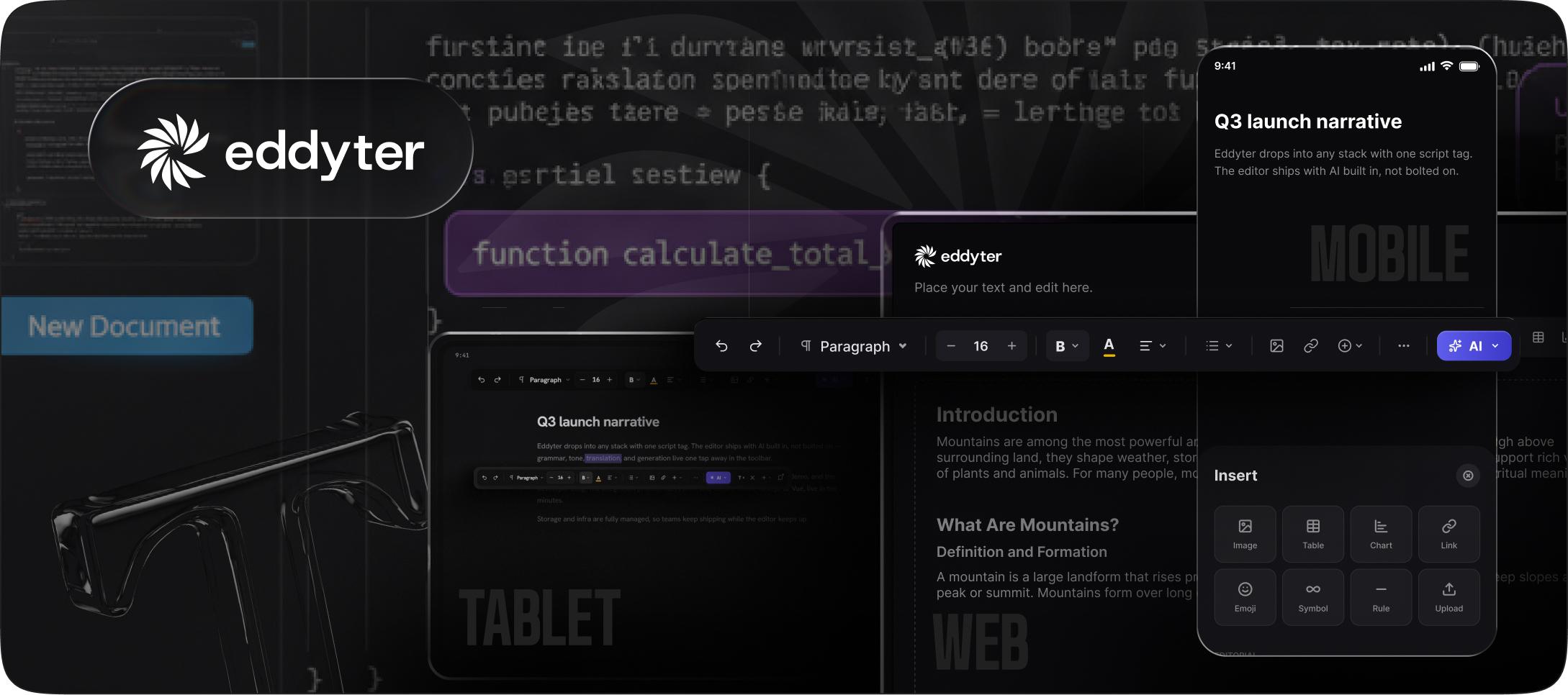
Eddyter is a plug-and-play WYSIWYG editor built on Meta's Lexical framework. Ships as a complete production-ready editor with multi-model AI (GPT-5, Claude Sonnet 5, Haiku 4.5, Gemini 3), advanced tables, slash commands, block reordering, ghost-text autocomplete, and clean HTML output.
Founded by Craxinno Technologies. Distributed as an npm package. Available across 7 frameworks — React 18.2+/19, Next.js 14/15, Vue 3, Angular 17-20, Svelte 4/5, Laravel, and Vanilla JS.
Eddyter's Value Proposition
Ship a complete production-ready editor in 10 minutes with multi-model AI included and flat predictable pricing. No infrastructure. No AI service to wire up. No per-user costs that scale unpredictably.
Eddyter in 2026
Eddyter has grown quickly in 2026 by combining three things few competitors match: multi-model AI included in Premium plans, 7-framework support across the modern web ecosystem, and flat pricing that doesn't scale per user.
The catch: it's a paid product with subscription tiers. The free tier is usable but capped at 100 MB storage and 100 editor loads per month. Real production use starts at $12/mo Starter.
For deeper Eddyter analysis, see BlockNote vs Eddyter 2026 and Best Lexical Alternative 2026.
What Is Slate?
Slate is a highly customizable React-based framework for building rich text editors. Not an editor. A toolkit. You install it and stare at a blank canvas where every feature — toolbar, menus, keyboard shortcuts, AI, tables, images, links, code blocks, everything — is yours to build.
Started in 2016. Free MIT license forever. Active but community-maintained. Popular for teams building editors with unique document schemas that off-the-shelf editors can't handle.
Slate's Value Proposition
Total control over document model, rendering, and behavior. If you need an editor with unique content structures — legal contracts with clause-level metadata, medical records with regulated fields, music notation, DNA sequences — Slate lets you build exactly what you need.
Slate in 2026
Slate remains a popular choice for teams with specialized editor requirements. But the ecosystem has fragmented — TipTap and Lexical (which powers Eddyter) took much of the general-purpose editor market that Slate once served. Slate today is best positioned for narrow specialized use cases.
The catch: it's a toolkit, not an editor. Setup takes 4-8 weeks minimum. You maintain the UI layer forever. React 19 support requires community wrapper updates. Historical breaking changes between versions have burned teams.
For deeper analysis, see TipTap vs Slate 2026.
Head-to-Head Comparison
Here's how Eddyter and Slate compare across the 12 dimensions that matter most:
1. Setup Time
Eddyter: 10 minutes. Install package. Add API key. Ship.
Slate: 4-8 weeks. Install package. Build every UI element from scratch. Wire up AI. Handle edge cases. QA.
Winner: Eddyter — 500-2000x faster to production.
2. Framework Support
Eddyter: React 18.2+/19, Next.js 14/15, Vue 3, Angular 17-20, Svelte 4/5, Laravel, Vanilla JS (7 frameworks).
Slate: React only. No Vue, Angular, Svelte, Laravel, or Vanilla JS support.
Winner: Eddyter — supports 7 frameworks vs Slate's 1.
3. UI Included
Eddyter: Complete UI included — toolbar, menus, block picker, drag handles, slash commands, AI popover, table controls.
Slate: No UI. Zero. You build every button, every menu, every popover yourself.
Winner: Eddyter for teams without dedicated UI engineering time.
4. AI Features Built In
Eddyter: Multi-model AI built in on Premium plans (Pro $29/mo, AI Pro BYOK $39/mo, AI Pro Managed $59/mo). Choose between GPT-5, Claude Sonnet 5, Haiku 4.5, or Gemini 3 per action.
Slate: No AI features. Build from scratch with Vercel AI SDK (5-8 weeks additional engineering).
Winner: Eddyter — multi-model AI included at flat pricing.
5. Bundle Size
Eddyter: ~140 KB (all features included).
Slate: ~120 KB core + everything you build on top. Production bundles typically reach 200+ KB.
Winner: Eddyter for production-ready comparison. Slate wins the raw core size but nothing usable ships at 120 KB.
For detailed bundle comparison, see Rich Text Editor Bundle Size Comparison 2026.
6. Tables
Eddyter: Advanced tables with cell merging, column and row resizing, alignment control, and sortable headers.
Slate: No native tables. Build from scratch (2-3 weeks of engineering).
Winner: Eddyter — production-quality tables out of the box.
7. Code Blocks
Eddyter: Native code blocks with Shiki-powered syntax highlighting for 20+ languages.
Slate: No native code blocks. Build custom (1-2 weeks with syntax highlighting).
Winner: Eddyter — production-ready code blocks.
8. Image Handling
Eddyter: Native image blocks with drag-and-drop upload, resize handles, and cloud storage integration on Premium plans.
Slate: No native image handling. Build from scratch (1-2 weeks including upload, resize, storage).
Winner: Eddyter — richer image UX with managed storage.
9. Extensibility
Eddyter: Extensible via configuration. Custom slash commands via config. Custom nodes via Lexical foundation.
Slate: Highly extensible — every content type is a custom element or leaf. Complete document model control.
Winner: Slate for deep customization. Eddyter for config-driven extensibility.
10. Documentation
Eddyter: Mature docs at eddyter.com/docs. Video tutorials. Dedicated founder support (Nimish).
Slate: Community docs. Growing but uneven. Historical breaking changes complicate learning path.
Winner: Eddyter — polished docs with active support channel.
11. Real-Time Collaboration
Eddyter: Native real-time collaboration launches Q3 2026. Included in AI Pro Managed ($59/mo).
Slate: No native RTC. Build custom Y.js integration (3-6 weeks additional engineering).
Winner: Eddyter (post-Q3 2026). Custom Slate RTC is possible but expensive.
12. Pricing
Eddyter: Free tier (100 MB, 100 loads/mo) → Starter $12/mo → Pro $29/mo → AI Pro BYOK $39/mo → AI Pro Managed $59/mo.
Slate: Free MIT forever. AI, collaboration, tables, code blocks, images — all custom builds costing $30K-$70K+ in engineering time.
Winner: Depends. Slate wins on license cost only. Eddyter wins on total cost of ownership.
Complete Feature Matrix
Feature | Eddyter | Slate |
|---|---|---|
License | Proprietary + free tier | MIT (free) |
Frameworks | React, Next.js, Vue 3, Angular 17-20, Svelte 4/5, Laravel, Vanilla JS | React only |
Setup time | 10 minutes | 4-8 weeks |
UI included | ✅ Complete | ❌ Build everything |
Multi-model AI | ✅ GPT-5, Claude, Gemini | 🔧 Build custom |
Ghost text autocomplete | ✅ Native | 🔧 Build custom |
Slash commands | ✅ Native | 🔧 Build custom |
Tables | ✅ Advanced | 🔧 Build custom |
Code blocks (20+ langs) | ✅ Shiki-powered | 🔧 Build custom |
Image upload | ✅ Drag-and-drop + storage | 🔧 Build custom |
Video embeds | ✅ YouTube/Vimeo native | 🔧 Build custom |
Mentions (@user) | ✅ Native | 🔧 Build custom |
Real-time collaboration | 🔜 Q3 2026 native | 🔧 Build Y.js custom |
Track changes | 🔜 Q4 2026 native | 🔧 Build custom |
Comments & annotations | 🔜 Q4 2026 native | 🔧 Build custom |
Bundle size | ~140 KB | ~120 KB core + everything built |
HTML output | ✅ Clean semantic | 🔧 Custom serializer |
TypeScript | ✅ Full support | ✅ Full support |
Custom document model | ⚠️ Config-based | ✅ Total control |
Free tier | ✅ 100 MB / 100 loads/mo | ✅ Everything free (MIT) |
Base price | $12/mo Starter | $0 |
3-year total (with AI + collab) | $2,124 | $52,000-$85,000 |
Setup Code Comparison
The setup code makes the "10 minutes vs 4-8 weeks" difference tangible.
Eddyter Setup (10 Minutes to Production)
Step 1 — Get your API key
Visit eddyter.com/user/license-key. Copy your key. Add it to .env.local:
bash
Step 2 — Install Eddyter
bash
Step 3 — Render the editor
tsx
What ships out of the box:
- Complete formatting toolbar
- Slash commands with block picker
- Drag-and-drop image upload
- Advanced tables with cell merging
- Code blocks with syntax highlighting
- Ghost-text autocomplete (with AI enabled)
- Multi-model AI slash commands (with AI enabled)
- Clean semantic HTML output
- Full theme support (light/dark mode)
Time to production: 10 minutes.
Slate Setup (4-8 Weeks to Production)
tsx
What this basic Slate editor does:
- Renders text (that's it)
- Basic paragraph and heading rendering
- No toolbar (you build it)
- No formatting keyboard shortcuts (you build them)
- No lists, no blockquotes, no code blocks (you build them)
- No images, no tables (you build them)
- No links, no mentions (you build them)
- No AI, no slash commands (you build them)
- No history/undo behavior beyond
withHistory(customize it) - No serialization to HTML (you build a serializer)
Then you build (each item is 3 days to 3 weeks of work):
- Custom toolbar component (~500 lines)
- Keyboard shortcut handlers (~200 lines)
- Custom nodes for headings, lists, blockquotes, code blocks (~300 lines)
- Image upload with resize handles (~400 lines)
- Table component with cell merging (~600 lines)
- Link handling with tooltips (~200 lines)
- Serializer to convert Slate JSON to HTML (~300 lines)
- Deserializer to load HTML into Slate (~300 lines)
- AI streaming integration with Vercel AI SDK (~500 lines)
- Slash command menu with fuzzy search (~400 lines)
- Mentions with autocomplete (~500 lines)
- Custom CSS for every custom element
Total: 4-8 weeks of engineering to reach Eddyter's out-of-box UX.
The trade-off is clear: Eddyter is faster to ship. Slate offers deeper customization when you finish shipping.
For deep-dive on custom Slate patterns, see How WYSIWYG Editors Work in 2026.
3-Year Cost Math: Real Numbers
For a typical React SaaS with 1,000 monthly active users needing AI + collaboration + tables + code blocks:
Custom Build on Slate
- Senior engineering (5 weeks initial build): $30,000
- Custom AI integration with Vercel AI SDK (3 weeks): $18,000
- Custom Y.js collaboration integration (3-4 weeks): $21,000
- Ongoing maintenance (10 hrs/mo × $150/hr × 36 mo): $54,000
- OpenAI GPT-5 API costs: $28,800
- 3-year total: $151,800
Custom Build on Slate + Cost Optimization
- Same as above except:
- API costs optimized 40% via model tiering: $17,280 (was $28,800)
- 3-year total: $140,280
Slate Free MIT (No AI, Just Custom UI)
- Senior engineering (5 weeks initial build): $30,000
- Ongoing maintenance (5 hrs/mo × $150/hr × 36 mo): $27,000
- 3-year total: $57,000
- Limitation: no AI, no collaboration
Eddyter AI Pro Managed
- Base plan: $59/mo × 36 = $2,124
- Includes: multi-model AI (GPT-5, Claude Sonnet 5, Haiku 4.5, Gemini 3), Q3 2026 native RTC, all editor features, infrastructure, ongoing updates, 7-framework support
- 3-year total: $2,124
The Real Savings
Approach | 3-Year Cost | vs Eddyter |
|---|---|---|
Eddyter AI Pro Managed | $2,124 | Baseline |
Slate Free MIT (no AI) | $57,000 | +$54,876 |
Custom Slate + AI + Collab (optimized) | $140,280 | +$138,156 |
Custom Slate + AI + Collab | $151,800 | +$149,676 |
The takeaway: Slate's "free MIT license" only matters if editor engineering is your core product differentiator. For teams building editors AS A FEATURE, Eddyter saves $55K-$150K over 3 years while shipping in 10 minutes instead of 4-8 weeks.
For build-vs-buy analysis, see Build vs Buy: Real Cost of Building a Rich Text Editor 2026 and Why Building Your Own Rich Text Editor Is a Startup Killer.
5-Question Decision Framework
Use this to decide which fits your team:
1. Is editor architecture your core product differentiator?
Yes (building a specialized editor product) → Slate. Total document model control matches your product's uniqueness.
No (editor is a feature) → Eddyter. Managed editor delivers 95% of the value with 3% of the engineering cost.
2. What frameworks does your product use?
React only → Either works.
React + Vue + Angular + Svelte → Eddyter. Slate is React-only. Eddyter supports 7 frameworks natively.
3. Do you have 4-8 weeks of senior engineering bandwidth?
Yes with no other priorities → Slate is possible. If your team can dedicate 4-8 weeks of senior engineers exclusively to editor work.
No → Eddyter. 10-minute setup vs 4-8 weeks is a 500-2000x time saving.
4. Do you need multi-model AI?
Yes → Eddyter. GPT-5, Claude Sonnet 5, Haiku 4.5, Gemini 3 built in with per-command overrides.
Single AI model OK → Eddyter or custom Slate.
No AI needed → Slate free MIT works.
5. What's your budget model?
True zero-budget prototype (React only, no AI, no collab) → Slate free MIT.
Flat predictable pricing → Eddyter $12-$59/mo.
Willing to invest $50K-$150K in engineering to save on subscription → Custom Slate build.
Real Use Cases: When Each One Wins
When Slate Wins
1. Building specialized editor products.
Legal contract editors with clause-level metadata. Medical records with regulated fields. Music notation editors. DNA sequence editors. Slate's total document model control fits these unique cases.
2. Teams with dedicated editor engineering.
If you have a full-time engineer whose only job is the editor, Slate lets that engineer build exactly what your product needs.
3. Open-source editor projects.
Community projects building editors as their core focus. Slate's MIT license and community fit open-source contribution patterns.
4. Editors with unique document schemas.
If your content structure fundamentally doesn't fit rich text or block-based models, Slate gives you a blank slate (pun intended) to build your own model.
When Eddyter Wins
1. SaaS products where editor is a feature.
If your product needs an editor but the editor isn't your product, Eddyter delivers production quality in 10 minutes vs 4-8 weeks of Slate engineering.
2. Multi-framework products.
React + Vue + Angular + Svelte + Laravel + Vanilla JS teams. Slate is React-only. Eddyter's 7-framework support eliminates rebuild cycles.
3. AI-first products.
Multi-model AI (GPT-5, Claude Sonnet 5, Haiku 4.5, Gemini 3) built in beats Slate's 5-8 weeks of custom AI integration.
4. Teams shipping this week.
10-minute setup vs 4-8 weeks isn't a marginal difference. It's a strategic difference in time-to-market.
5. Teams needing predictable pricing at scale.
Flat $12-$59/mo pricing beats variable engineering time cost of Slate maintenance ($27K-$54K over 3 years).
6. Teams building modern React 19 / Next.js 15 apps.
Eddyter is purpose-built for React 18.2+/19 with first-class Next.js App Router support ("use client" directive). Slate has community wrapper lag with new React versions.
7 Common Pitfalls in the Eddyter vs Slate Decision
Teams making this comparison consistently hit these issues. Avoiding each is required for a correct choice.
Pitfall 1: Underestimating Slate's Engineering Time
"We'll build the toolbar in a week." Actual: 3 weeks with edge cases. "We'll add AI in 2 weeks." Actual: 5-8 weeks including streaming, cost controls, error handling. Slate's engineering time consistently doubles from initial estimates.
Fix: Budget 2x your initial Slate estimate. If that number makes you uncomfortable, pick Eddyter instead.
Pitfall 2: Picking Slate for a Multi-Framework Product
Slate is React-only. Teams building for React + Vue + Angular + Svelte fight community wrappers that lag official Slate updates.
Fix: Multi-framework → Eddyter (7 frameworks natively). Or TipTap (4 frameworks). Skip Slate.
Pitfall 3: Assuming "Free MIT" Means Zero Cost
Slate's MIT license is free. Slate implementation isn't. A "free" Slate editor costs $30K-$150K over 3 years in engineering time. Compare that to Eddyter's $2,124 subscription cost.
Fix: Model 3-year TCO before deciding. License cost is 1-5% of total cost.
Pitfall 4: Building Custom AI on Slate When You Don't Need To
Some teams see Eddyter's AI-included tier and think "we'll build our own AI on Slate free." Then they spend 5-8 weeks building AI integration that Eddyter provides in a config flag. Only build custom if AI UX is your core differentiator.
Fix: Compare AI implementation cost ($15K-$25K + ongoing) vs Eddyter's $59/mo AI Pro Managed. Math almost always favors Eddyter.
Pitfall 5: Slate Version Upgrade Pain
Slate has a history of breaking changes between versions. Upgrading a production Slate deployment can take 2-4 weeks of engineering per major version.
Fix: Factor in upgrade costs. Eddyter handles all upgrades internally — your integration keeps working automatically.
Pitfall 6: Ignoring Bundle Size Reality
"Slate is 120 KB" is technically true — but it's the core only. Your production Slate bundle with all the custom UI, tables, code blocks, images, and AI ships closer to 250-350 KB.
Fix: Measure your bundle after implementing what you actually need. Compare to Eddyter's ~140 KB with everything included.
Pitfall 7: Not Testing Notion-Clone Use Cases
Some teams pick Slate expecting to build a Notion clone. Slate's flexibility is a burden here — building block UX from scratch takes 6-8 weeks.
Fix: For Notion-style UX, use BlockNote or Eddyter. Skip Slate for block-based products.
When Neither Path Is Right
Three scenarios where neither Eddyter nor Slate fits:
1. Highly Structured Content Editors
Code editors, formula editors, math editors. Different UX needs. Consider Monaco Editor, CodeMirror, or specialized libraries instead.
2. Very Short Content
Single-line inputs, search boxes, comment fields under 100 characters. Both editors are overkill.
3. Read-Only Content Rendering
If you only need to display rich content (not edit it), skip editor frameworks entirely. Use dangerouslySetInnerHTML with DOMPurify sanitization.
Migration Between Them
If you're already on one and considering the other:
Migrating Slate → Eddyter
Slate outputs custom JSON. Eddyter accepts HTML via initialContent. Migration path:
- Build a Slate JSON → HTML serializer for your specific schema
- Convert all existing Slate documents to HTML
- Pass HTML to Eddyter via
initialContent - Save Eddyter HTML going forward
Estimated engineering time: 1-3 weeks for 10K documents including serializer + validation.
Migrating Eddyter → Slate
Eddyter outputs HTML. Slate accepts HTML via custom deserializer:
- Build an HTML → Slate JSON deserializer for your document types
- Extract HTML from Eddyter storage
- Convert to Slate JSON via your deserializer
- Save Slate JSON going forward
- Build the entire custom UI (4-8 weeks)
Estimated engineering time: 6-10 weeks including deserializer + UI build.
Migration to Eddyter is much easier than migration away from it because Eddyter uses standard HTML output while Slate uses proprietary JSON.
For detailed migration methodology, see Rich Text Editor Migration Checklist 2026.
Frequently Asked Questions
1. What's the difference between Eddyter and Slate for React apps in 2026?
Eddyter is a managed AI-native WYSIWYG editor built on Meta's Lexical framework — ships as a complete production-ready editor with multi-model AI (GPT-5, Claude Sonnet 5, Haiku 4.5, Gemini 3) built in, 7-framework support, and $12-$59/mo flat pricing. Setup takes 10 minutes. Slate is a React-only framework for building custom editors — MIT license (free), total document model control, but requires 4-8 weeks of engineering to reach production quality. No AI, no tables, no code blocks, no UI included — you build everything. Pick Eddyter for editor-as-a-feature products. Pick Slate for editor-as-a-product with unique document schemas and dedicated engineering resources.
2. Is Slate really free forever?
Slate's MIT license is free forever — no subscription, no per-user fees, no vendor lock-in. But "free license" doesn't mean "free implementation." A production Slate editor costs $30,000-$150,000 in engineering time over 3 years to build and maintain (5+ weeks initial build + ongoing maintenance + AI/collaboration integrations). Compare that to Eddyter AI Pro Managed at $2,124 over 3 years including multi-model AI, real-time collaboration (Q3 2026), tables, code blocks, images, and infrastructure. Slate's "free" status only matters for teams where editor architecture is a core differentiator worth the engineering investment.
3. Does Slate support multi-model AI like Eddyter?
No. Slate has no built-in AI features. Adding AI requires 5-8 weeks of custom engineering — integrate Vercel AI SDK, build streaming rendering, create slash command UI, implement rate limiting, add cost controls, and handle edge cases. Multi-model support (GPT-5, Claude Sonnet 5, Haiku 4.5, Gemini 3 together) requires additional provider abstraction work. Eddyter includes multi-model AI built in on Premium plans — GPT-5, Claude Sonnet 5, Haiku 4.5, and Gemini 3 all available at $29-$59/mo flat pricing. For AI implementation patterns, see How to Add AI Autocomplete to a React Editor 2026 and How to Add AI Slash Commands to Any React Editor 2026.
4. How long does it take to build a production Slate editor?
Building a production-ready Slate editor comparable to Eddyter's out-of-box quality takes 4-8 weeks of senior engineering time in 2026. This covers: custom toolbar component (3-5 days), keyboard shortcut handlers (2-3 days), custom nodes for headings/lists/blockquotes/code blocks (5-7 days), image upload with resize handles (5-7 days), table component with cell merging (10-14 days), link handling (2-3 days), HTML serializer/deserializer (5-7 days), AI streaming integration (10-14 days), slash command menu (5-7 days), and QA/edge cases (5-7 days). Total 3-year cost including engineering and infrastructure: $57,000-$151,800. Eddyter delivers equivalent functionality in 10 minutes at $2,124 over 3 years.
5. Which frameworks does Slate support vs Eddyter?
Slate supports React only. There are no official Vue, Angular, Svelte, or Vanilla JS bindings. Community wrappers exist for some frameworks but aren't officially maintained and lag behind Slate updates. Eddyter supports 7 frameworks natively — React 18.2+/19, Next.js 14/15, Vue 3 via @eddyter/vue, Angular 17-20 via @eddyter/angular, Svelte 4/5 via @eddyter/svelte, Vanilla JS via @eddyter/core, and Laravel via eddyter/laravel Composer package. For multi-framework products, Eddyter's coverage eliminates the need to rebuild the editor per framework — a 4-6 week savings.
6. Which has better documentation — Eddyter or Slate?
Eddyter has mature documentation at eddyter.com/docs with video tutorials, integration guides for all 7 frameworks, and dedicated founder support (Nimish). Documentation is actively maintained with each product release. Slate has community documentation that has grown over years but remains uneven — some areas well-covered, others sparse. Historical breaking changes complicate learning path (docs for older versions still float in search results). For teams new to the editor, Eddyter's polished docs deliver faster time-to-first-success. For teams with deep editor engineering experience, Slate's community forums and GitHub discussions provide adequate support.
7. Can I use Slate for a Notion clone?
Technically yes, practically no. Slate's flexibility becomes a burden for block-based UX — you build the entire block model, drag-and-drop reordering, slash command menu, and block picker UI from scratch (6-8 weeks additional to standard Slate setup). For Notion clones, BlockNote (block-based, MPL 2.0 free, React only) or Eddyter (block-style via slash commands, 7 frameworks) are significantly better choices. Building a Notion clone on Slate takes 10-14 weeks total vs 1-2 hours for BlockNote or 10 minutes for Eddyter. For deeper analysis, see Best Rich Text Editor for Notion Clones 2026 and BlockNote vs Eddyter 2026.
8. What's the bundle size difference between Eddyter and Slate?
Eddyter bundles at ~140 KB with all features included — tables, code blocks with syntax highlighting, images, AI integration, slash commands, mentions. Slate core is ~120 KB but production bundles are much larger. Adding tables (~30-50 KB custom code), syntax highlighting (~40-60 KB), image handling (~20-30 KB), and AI streaming (~30-50 KB) typically pushes Slate production bundles to 250-350 KB. For fair bundle comparison, measure Slate after implementing what your product actually needs — not just the raw core. Eddyter's included ~140 KB beats production Slate bundles significantly for mobile-first products where Core Web Vitals matter.
9. Can I migrate from Slate to Eddyter?
Yes. Slate outputs its custom JSON schema. Eddyter accepts HTML via initialContent prop. Migration path: (1) Build a Slate JSON → HTML serializer for your specific schema (3-5 days), (2) Convert all existing Slate documents to HTML (background job), (3) Pass HTML to Eddyter via initialContent, (4) Save Eddyter HTML going forward. Estimated total migration time: 1-3 weeks for 10K documents including serializer build, testing, and rollback plan. Migration to Eddyter is much easier than migration away from it because Eddyter uses standard HTML output while Slate uses proprietary JSON structure. For methodology, see Rich Text Editor Migration Checklist 2026.
10. When should I pick Slate over Eddyter?
Pick Slate when: (1) You're building a specialized editor product where the document model is your core differentiator — legal contract editors, medical records, music notation, DNA sequences. (2) You have 4-8 weeks of dedicated senior engineering time for the initial build. (3) You have ongoing engineering capacity for maintenance (10 hrs/mo minimum). (4) Your product is React-only with no multi-framework requirements. (5) You need total document model control that off-the-shelf editors can't provide. For every other scenario — SaaS products with editor as a feature, multi-framework products, AI-native writing tools, teams shipping this week — Eddyter delivers better outcomes at dramatically lower total cost. The 3-year cost difference ($2,124 vs $57K-$152K) rarely justifies custom Slate builds outside specialized use cases.
Ready to Pick Your Editor?
Both Eddyter and Slate are strong choices for their specific use cases. The right one depends on whether editor architecture is your core product or a feature that supports your core product.
Pick Slate if: You're building a specialized editor product with unique document schemas, have 4-8 weeks of dedicated senior engineering time, and React-only requirements.
Pick Eddyter if: You need a production-ready editor with multi-model AI (GPT-5, Claude Sonnet 5, Haiku 4.5, Gemini 3), 7-framework support (React, Next.js, Vue 3, Angular 17-20, Svelte 4/5, Laravel, Vanilla JS), flat predictable pricing, or 10-minute setup with no infrastructure work.
Try Eddyter free — 100 MB storage, 100 editor loads per month, no credit card required.
👉 Try Eddyter free at eddyter.com
📚 Read the docs
💰 See pricing
🎥 Watch the intro video | Watch the 30-min integration guide

Written by
Shreya Taneja
Project Manager