Total Views
694
Read Time
17 min read
Updated On
29.09.2026
Introduction
Why Building Your Own Rich Text Editor Is a Startup Killer (And What to Do Instead)
Building your own rich text editor will cost your startup $69K–$130K over 3 years — and the opportunity cost is even worse. Here's what to do instead in 2026.
Content
Why Building Your Own Rich Text Editor Is a Startup Killer (And What to Do Instead)
Every few months, a founder makes the same fatal decision: "We'll just build our own editor. How hard could it be?" Three months later, they have a half-working toolbar, no AI features, mobile bugs they can't track down, and a roadmap that's three sprints behind because their senior engineer has been buried in editor work.
This post is the honest case against building your own rich text editor in 2026 — and a clear breakdown of what you should do instead. It's written for startup founders, technical co-founders, and CTOs who are tempted by the "we'll just build it" trap. By the end, you'll have the math, the war stories, and the framework to make the right infrastructure call.
The short version: building your own rich text editor is one of the most consistently fatal decisions early-stage startups make. Here's why, and what to do instead.
The Founder's Temptation: "How Hard Could It Be?"
Every founder who's ever considered building their own editor has thought some version of this:
- "It's just bold, italic, and a few buttons. We can knock this out in a sprint."
- "We've got Lexical/ProseMirror/Slate — those are free frameworks."
- "Our editor needs to be special. Off-the-shelf options won't fit our brand."
- "AI tools like Cursor can scaffold the whole thing for us in a day."
- "It'll save us money long-term — no subscription fees."
Every one of these is wrong. Not because building an editor is impossible — it's possible. But because the actual cost of building, maintaining, and shipping a production-grade editor is dramatically higher than founders estimate. And the opportunity cost — what your team isn't shipping while they're stuck in editor hell — is what actually kills startups.
Let's break down each of those assumptions.
The Real Cost of Building Your Own Editor
Here's the brutal math no one shares when founders are deciding to "just build it":
Year 1 Development Cost
A production-grade rich text editor requires:
Component | Senior Engineer Time | Cost @ $15K/mo |
|---|---|---|
Toolbar component (basic) | 2–4 days | $1,500–$3,000 |
Bubble menu / floating menu | 1–3 days | $750–$2,250 |
Image upload UI with resize | 1–2 days | $750–$1,500 |
Table UI with merge/resize | 3–5 days | $2,250–$3,750 |
Slash command menu | 1–3 days | $750–$2,250 |
AI chat interface | 3–7 days | $2,250–$5,250 |
AI autocomplete integration | 3–5 days | $2,250–$3,750 |
Mobile responsive passes | 2–4 days | $1,500–$3,000 |
Accessibility compliance | 2–4 days | $1,500–$3,000 |
Paste handling edge cases | 2–5 days | $1,500–$3,750 |
Dark mode | 1–2 days | $750–$1,500 |
Browser compatibility fixes | 2–4 days | $1,500–$3,000 |
Documentation for your team | 1–2 days | $750–$1,500 |
Total | 24–50 days | $18,000–$37,500 |
That's $18K–$37K of senior engineering time to ship a minimum viable editor. And that's optimistic — most teams overrun by 50–100%.
The Ongoing Cost (Year 2+)
Building it is just the beginning. Every year afterward, you'll spend:
- Maintenance — bug fixes, edge case handling, security patches (1–2 days/month)
- Feature parity catch-up — competitor editors add features; you need to match them (5–10 days/quarter)
- Framework updates — React 19 → 20, Next.js 14 → 15 → 16, breaking changes in upstream libraries (3–5 days/major release)
- Browser compatibility — new browser releases break edge cases (1–2 days/quarter)
- AI model upgrades — GPT/Claude/Gemini update their APIs, you re-integrate (2–4 days/quarter)
That's 30–60 days of senior engineering time per year in ongoing maintenance alone. At $15K/month, that's $22K–$45K per year, every year, forever.
The Opportunity Cost (The One That Actually Kills Startups)
This is the cost founders never calculate, and it's the one that actually kills startups:
While your senior engineer is building the editor:
- They're not shipping the features that differentiate your product
- They're not closing the technical debt that's slowing the team
- They're not building the integrations customers are asking for
- They're not improving the onboarding that's hurting conversion
For a startup, opportunity cost compounds. The features you didn't ship in Q1 cost you customers in Q2, which cost you revenue in Q3, which cost you the funding round in Q4. Editor work doesn't just cost engineering time — it costs strategic momentum.
The Hidden Pitfalls Founders Don't See
Even if you accept the cost above and decide to build anyway, here are the pitfalls that compound the problem:
1. "AI Tools Will Save Us" Is Half True
AI coding tools like Cursor, Claude, and Lovable can scaffold parts of an editor — but they can't ship a production-grade one. AI tools accelerate boilerplate. They don't shortcut fundamental complexity. Building an editor with AI tools cuts time by maybe 30%, not 90%. You still own every bug, edge case, and maintenance burden.
2. The "Free Framework" Trap (Lexical, ProseMirror, Slate)
Founders pick free frameworks thinking they'll save money. The frameworks themselves are free — but you're spending engineering time on everything else: toolbar UI, AI integration, mobile responsiveness, accessibility, browser compatibility. The framework is 10% of the work. The other 90% is yours.
3. The "We're Different" Justification
Founders convince themselves their editor needs are uniquely different from off-the-shelf editors. In 99% of cases, this isn't true. The vast majority of editor use cases are:
- Bold, italic, headings, lists
- Tables and images
- Some AI assistance
- Clean HTML output
If that's your use case (and it almost always is), you don't need a custom editor. You need a configurable one.
4. Edge Cases You've Never Considered
Real-world editor edge cases that consume weeks of debugging:
- Pasting from Microsoft Word (a special hell)
- Pasting from Google Docs (its own special hell)
- IME (Input Method Editor) support for Asian languages
- Touch keyboards on iOS/Android with different paste behaviors
- Screen reader navigation through complex content
- Drag-and-drop file handling across browsers
- Undo/redo with complex selections
- Copy-paste between tabs of the same editor
You'll hit every one of these in production. Each takes days to fix properly.
5. The Maintenance Treadmill
Even after you ship "version 1" of your editor:
- React 19 dropped → you need to update your editor
- Next.js 15 changed App Router behavior → you need to refactor
- A new browser version breaks paste handling → emergency fix
- Your customer adds a Word document with unusual formatting → 2 days of debugging
- AI model APIs change → you re-integrate
This treadmill never stops. And it never accelerates your product. It just keeps you running to stay in place.
What Successful Startups Actually Do Instead
Smart founders treat the editor as infrastructure, not as their product. They pick a proven editor solution, integrate it in minutes, and spend their engineering time on what makes their product unique.
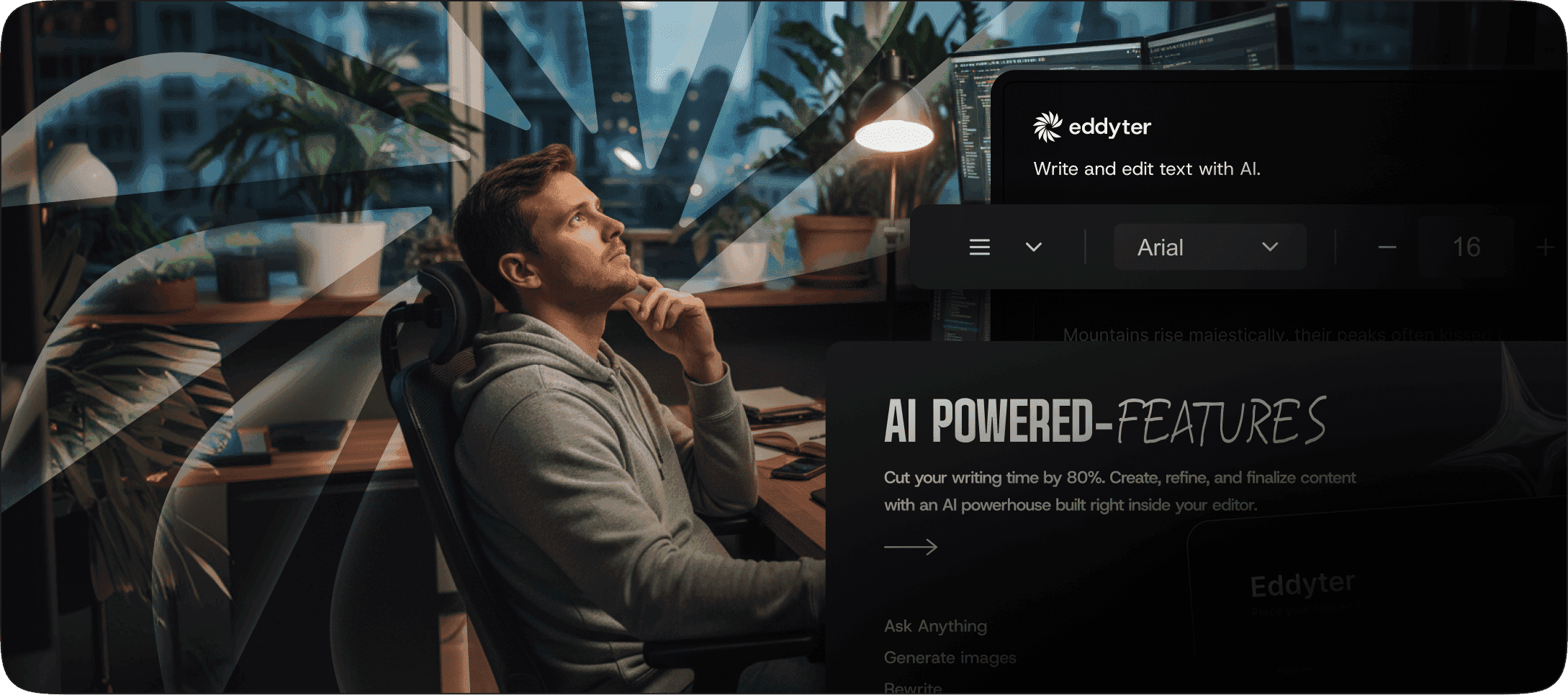
In 2026, the right answer for most React/Next.js startups is Eddyter — built on Meta's Lexical framework, with AI features included, predictable pricing, and 10-minute integration.
🎥 New to Eddyter? Watch the 2-minute overview: What is Eddyter? Why Developers Are Switching to This AI Editor (2026)
Why Eddyter Solves the Build-vs-Buy Problem
It's not the editor's "right tool" — it's the right approach. Eddyter is designed specifically for the situation founders find themselves in:
- ✅ Complete out of the box — no toolbar to build, no UI to assemble
- ✅ AI built in on Premium plans — no AI integration project
- ✅ Modern Lexical foundation — won't go obsolete
- ✅ Predictable subscription pricing — $12–$59/mo, no surprises
- ✅ 3-step integration — minutes, not weeks
- ✅ Managed infrastructure — no editor backend to scale
- ✅ Active development — features and fixes shipped for you
For comparison: building an editor that matches Eddyter's feature set would take a senior engineer 4–8 weeks of full-time work. Eddyter integrates in 10 minutes.
The 3-Step Integration (For Founders Watching the Math)
Step 1 — Get Your API Key
Go to https://eddyter.com/user/license-key, copy your API key, and add it to your environment variables.
Step 2 — Install Eddyter
bash
Step 3 — Basic Integration (Next.js / React)
jsx
That's it. Editor returns clean HTML via onChange. For advanced configuration, see the Eddyter documentation.
🎥 See real startup integration: Integrate Eddyter in 30 Minutes Using AI Tools — Cursor, Claude, Lovable
The Real Math: Build vs Buy Over 3 Years
Let's put concrete numbers on the build-vs-buy decision over 3 years:
Scenario A: Build Your Own Editor
Year | Cost |
|---|---|
Year 1: Initial build | $25,000–$40,000 (senior dev time) |
Year 2: Maintenance + features | $22,000–$45,000 |
Year 3: Maintenance + features | $22,000–$45,000 |
3-Year Total | $69,000–$130,000 |
+ Opportunity cost | Unmeasurable but real |
+ Editor bugs in production | Customer trust impact |
+ Senior dev burnout risk | High |
Scenario B: Use Eddyter (AI Pro Managed)
Year | Cost |
|---|---|
Year 1: $59/mo subscription + 10 min integration | $708 + $50 (engineer time) |
Year 2: $59/mo, automatic updates | $708 |
Year 3: $59/mo, automatic updates | $708 |
3-Year Total | $2,174 |
+ Opportunity cost | Zero — your engineers shipped product features |
+ Editor bugs in production | Eddyter handles them |
+ Senior dev focus | On what makes your product unique |
The Savings
Building your own editor costs $66,826–$127,826 more over 3 years than using Eddyter — and that's just the visible cost. The opportunity cost (features you didn't ship, customers you didn't convert, momentum you didn't build) is impossible to quantify but often much larger.
When Building Your Own Editor IS the Right Call
To be fair, there are rare cases when building your own editor makes sense:
1. The Editor IS Your Product
If you're building Notion, Linear, Figma, or another product where the editor itself is the core experience and differentiator — yes, build your own. The editor is your product.
2. You Have Genuinely Unique Document Model Requirements
If your content has a fundamentally non-standard structure that no existing editor can handle (specialized scientific notation, custom CAD-like document models, etc.), you may need to build. This is genuinely rare.
3. You're a Large Company With Dedicated Editor Teams
Companies like Atlassian, GitHub, and Meta have entire teams dedicated to editors. If you have the engineering resources to staff a team for this, building can make sense.
4. You're Selling Editor Tech as the Product
If your business model is selling the editor itself (you're trying to be the next TipTap or CKEditor), then obviously you need to build. But you're not a normal startup with editor needs — you're an editor company.
For everyone else — that is, 99% of startups — building your own editor is the wrong call. Picking a proven editor is the right one.
The Founder's Self-Check: Are You About to Make the Build Mistake?
If you're considering building your own editor, ask yourself these questions honestly:
1. Is the editor your core product, or is it infrastructure?
If users come to your product for the editor, build it. If users come to your product for something else and the editor is just a way to capture content, buy it.
2. Does my team have a senior engineer to dedicate to this for 4–8 weeks?
If not, you can't build it well. If yes, ask: is editor work the highest-leverage thing they could be doing? Almost always no.
3. Am I willing to maintain this forever?
Editors aren't one-and-done. They require ongoing maintenance, feature parity work, and framework upgrades. Forever.
4. Do I understand the edge cases?
Have you really thought through Microsoft Word paste handling? Mobile keyboards? IME support? Accessibility? If not, you don't yet know what you're signing up for.
5. What's the opportunity cost?
What features won't ship because your senior dev is in editor hell? What customers won't convert? What momentum will you lose?
If you can't answer "yes" to question 1 ("the editor is my core product") with conviction, you should not build your own editor. Period.
Three Real Stories From Founders Who Built (And Regretted It)
These are composite stories from founders who've shared their experiences in public forums:
Story 1: The Three-Month Delay
A YC-backed startup decided to build their own editor in Q1. They estimated 6 weeks. It took 13 weeks. During those 13 weeks, they missed their launch window, ran behind on a major customer commitment, and watched two competitors ship the feature their custom editor was supposed to enable. They eventually migrated to a third-party editor anyway.
Lesson: Build estimates are always optimistic. Real timelines are 2–3x what founders predict.
Story 2: The Forever Maintenance Burden
A Series A SaaS built their own editor in Year 1. By Year 3, they had spent 18 months of senior engineering time on it total — building plus maintenance. They eventually killed it and migrated to a third-party editor. The migration took another 8 weeks.
Lesson: The maintenance treadmill is real. Maintenance cost equals or exceeds build cost over time.
Story 3: The AI Catch-Up Trap
A Series B startup had built their own editor in 2022 — pre-AI. When ChatGPT launched and users started demanding AI features, they were stuck. They couldn't bolt AI on cleanly because their architecture wasn't designed for it. They spent 6 months rebuilding portions of the editor to add AI. By the time it shipped, competitors had been offering AI for a year.
Lesson: Building your own editor locks you into your architectural decisions. You can't adapt to category shifts the way modern editors can.
The pattern across all three stories: build estimates are wrong, maintenance is forever, and you can't keep up with category shifts.
What to Do Instead: A 4-Step Framework
Here's the framework for making the right editor decision:
Step 1 — Define Your Actual Editor Needs
List the editor features your product genuinely requires. Be honest. In most cases, the list is:
- Text formatting (bold, italic, headings, lists)
- Tables and images
- AI assistance
- Clean HTML output
- Mobile responsive
If your list matches this (and it usually does), an off-the-shelf editor will work. Skip to Step 2.
Step 2 — Pick a Modern Editor That Matches Your Stack
For most React/Next.js startups in 2026, Eddyter is the right choice:
- Modern Lexical foundation
- Native React 18.2+/19.x
- AI built in on Premium plans
- Predictable pricing
- 3-step integration
For other stacks or specialized needs, see our Best Rich Text Editors of 2026 comparison.
Step 3 — Integrate It in Under an Hour
Eddyter's 3-step setup means you can be done in 10 minutes. Other editors take longer but are still faster than building from scratch.
Step 4 — Ship Your Actual Product
With editor infrastructure in place, your senior engineer is now free to work on what differentiates your product. This is where startups win.
The whole framework takes less than a day to execute. Compared to 6–13 weeks of editor building, it's an obvious choice.
Frequently Asked Questions
1. Should I build my own rich text editor for my startup?
Almost never. Unless the editor itself is your core product (you're building Notion or Linear), use a proven third-party editor like Eddyter. Building your own takes 4–8 weeks of senior engineering time, costs $25K–$40K to ship, and requires ongoing maintenance forever — without any product differentiation benefit. See the Eddyter overview video for a quick demo of the alternative.
2. Can AI coding tools (Cursor, Claude) build an editor for me?
AI tools accelerate boilerplate by maybe 30% — they don't shortcut fundamental complexity. You can use AI to scaffold parts of an editor, but you'll still own toolbar building, AI integration, mobile responsiveness, accessibility, edge case handling, and maintenance forever. Picking a complete editor like Eddyter and using AI tools to integrate it is dramatically faster than using AI tools to build one from scratch.
3. Lexical, ProseMirror, and Slate are free — doesn't that save money?
The frameworks are free, but they're not editors — they're toolkits. You still build the UI, toolbar, slash commands, AI integration, mobile support, and accessibility yourself. The frameworks are 10% of the work; the other 90% is yours. For most startups, the engineering cost of building on these frameworks exceeds the subscription cost of a complete editor like Eddyter.
4. What if my editor needs are genuinely unique?
Almost always, "unique" needs map to standard features users actually want. Talk to actual users about what they want from an editor — most will describe bold, italic, headings, lists, tables, images, AI, and clean output. That's exactly what off-the-shelf editors deliver. If you genuinely have a custom document model that no existing editor can handle, that's the rare case where building makes sense.
5. How long does it take to add Eddyter to my React or Next.js app?
Under 10 minutes. Three steps: get your API key from eddyter.com/user/license-key, install with npm install eddyter, and render the component. See the step-by-step integration video for a walkthrough.
6. What does Eddyter cost vs building my own?
Eddyter ranges from free (genuine free tier) to $59/mo (AI Pro Managed with everything included). Building your own costs $25K–$40K in Year 1 plus $22K–$45K/year in ongoing maintenance. Over 3 years, building costs $69K–$130K vs Eddyter's $2,174 for a Premium subscription. The math overwhelmingly favors buying.
7. Does Eddyter have AI features?
Yes. AI Pro BYOK ($39/mo) lets you bring your own LLM API key. AI Pro Managed ($59/mo) includes 1,000 AI credits/month with full managed infrastructure. AI features include chat assistant, predictive autocomplete, tone refinement, and content suggestions — all built in.
8. What about my brand and custom styling needs?
Eddyter supports theming through CSS variables on .eddyter-scope — you can match any brand color palette. You can also customize toolbar positioning and which buttons appear. For 99% of branding needs, this is enough. For genuinely unique UI requirements, a headless framework like TipTap is the right alternative — though you'll spend weeks building the visual layer.
9. What if I outgrow Eddyter as we scale?
Eddyter scales from free tier to enterprise — most startups never outgrow it. Storage and AI credit add-ons let you grow without hitting hard limits. If you ever do need to migrate, Eddyter outputs clean semantic HTML that's portable to any modern editor — you're not locked in.
10. My CTO is convinced we should build. How do I push back?
Show them the math in this post. 3-year cost of building: $69K–$130K plus opportunity cost. 3-year cost of Eddyter: $2,174 plus 10 minutes of integration. Then ask: what features won't ship while we're building the editor? What customers won't convert? Most CTOs change their minds when they see the opportunity cost.
11. What if we just need a really simple editor — surely we can build that?
"Simple" editors quickly become complex. Even basic bold/italic/lists requires handling paste behavior, mobile keyboards, accessibility, browser compatibility, and edge cases. By the time your "simple" editor actually works in production, you've spent 2–4 weeks on it. Eddyter delivers far more capability than "simple" in 10 minutes.
12. Are there scenarios where I genuinely should build my own editor?
Yes, but rare: (1) the editor IS your product (you're building Notion-like apps), (2) you have genuinely unique document model requirements no existing editor handles, (3) you're a large company with dedicated editor teams, or (4) you're selling editor technology as your product. For 99% of startups, none of these apply.
13. Is buying an editor "outsourcing" something I should own?
No more than buying authentication (Auth0, Clerk), payments (Stripe), databases (PlanetScale, Neon), or hosting (Vercel) is "outsourcing." Editors are infrastructure. Modern startups don't build their own auth, payments, or databases — they use proven services. Editors are the same category.
The Bottom Line: Don't Be a Cautionary Tale
The startup founders who build their own editors usually fall into one of two camps:
- They eventually migrate to a third-party editor anyway, after losing 3–6 months of momentum
- They never quite ship the product they were trying to build, because the editor work consumed too much engineering capacity
Either way, building your own editor was the wrong call. The founders who picked a proven editor early and focused engineering on their actual product are the ones who shipped, raised, and won.
In 2026, the decision is clearer than ever. Modern editors like Eddyter offer:
- Genuinely fast integration (10 minutes)
- Built-in AI features (no separate integration)
- Predictable pricing (no usage surprises)
- Modern architecture (won't go obsolete)
- Active development (you don't maintain it)
For most startups, this is just obviously the right call. The "build it ourselves" temptation has killed more startups than it's helped.
Ready to Skip the Editor Trap?
Stop building infrastructure. Start shipping product. Drop Eddyter into your React or Next.js app today — 3 steps, under 10 minutes, AI features included, modern foundation. Your engineers get back to what makes your startup unique.
👉 Try Eddyter free at eddyter.com 📚 Read the docs 🎥 Watch the intro video | Watch the 30-min integration guide

Written by
Shreya Taneja
Project Manager